A working notebook. Things I'm thinking about, things I've made, things that aren't ready to be anything else.
Teaching Tools V1 — 4th May 2026
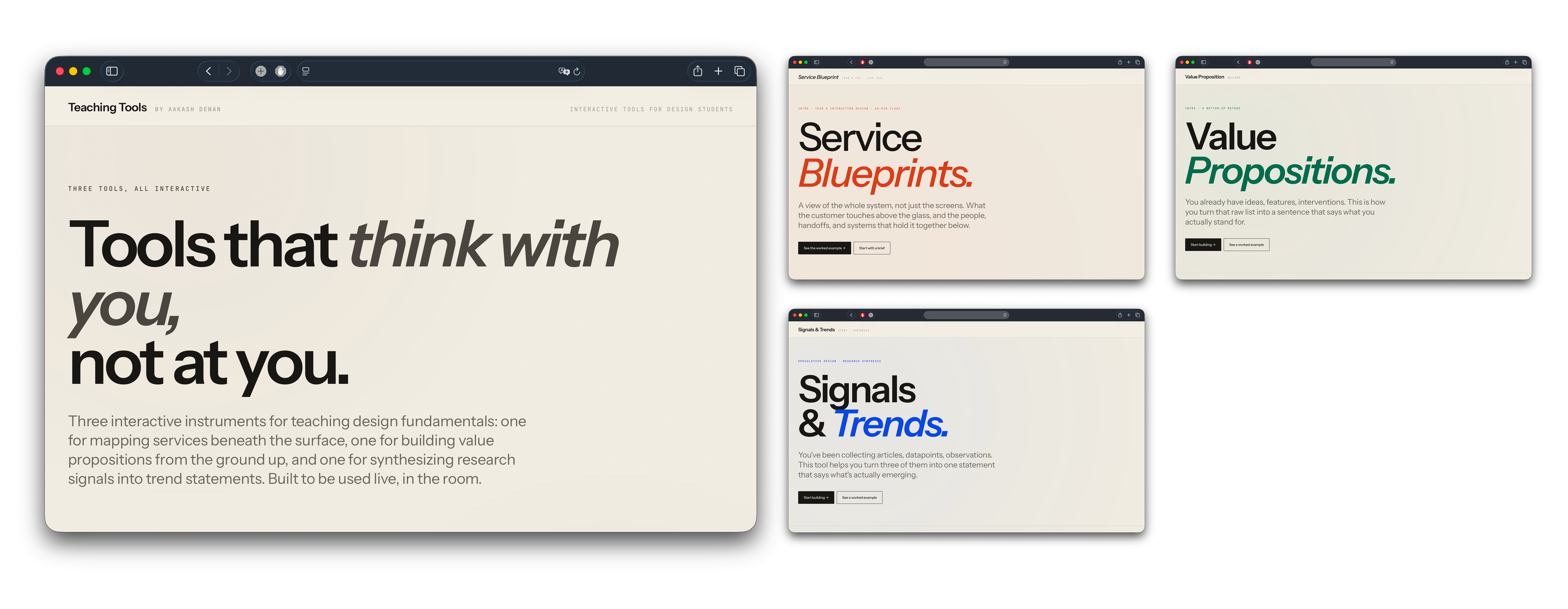
Three interactive tools I built to teach service blueprint, value proposition, and futures methods.
Service Blueprint Live — edit a blueprint in the browser, toggle into a journey-map view. Most service failures live below the line of visibility; the tool tries to make that work feel like the actual work.
Value Proposition Builder — a five-step bottom-up process: concrete enablers, clustered into engagement drivers, described, composed into a statement. Built because students tend to start at the statement and reverse-engineer the rest, which produces value props that sound right and don't survive contact with users.
Signals & Trends — STEEP as a scaffold for speculative work. Capture signals, pick the strongest three, articulate the connection, pressure-test the trend statement.
The tools were built with Claude as a coding partner across a few evenings. That fact is part of what they are, not a footnote.
For ten years, the gap between "I have a teaching method that works" and "I can hand students a thing they can use without me" was a developer's gap. Slides, whiteboards, printed canvases. The workshop couldn't leave the room with the students. Building the version that travelled was someone else's job and someone else's budget.
That gap has narrowed, not for production software, but for tools that need to work for twelve students for two hours. For things that small and that local, a designer who can prompt clearly can now close it themselves.
There's a term circulating for this: vibe coding. It's not quite right. Vibe coding is a specific posture: describe what you want, accept whatever the model writes, iterate on feel, never understand the code. The defining feature isn't AI involvement. It's disengagement from the decisions.
Every pedagogical choice here is deliberate. Where the AI appears and where it doesn't. What constraints are enforced versus encouraged. What each step is supposed to do to a student's thinking. I couldn't have written the JavaScript, but I could brief another developer, human or AI, to extend any of these tomorrow. The mental model is mine.
The art director doesn't draw the curves. That's not a disclaimer. The design thinking is the work.
The interesting question isn't whether this is good or bad. It's what teaching becomes when the instruments stop being aspirational. These tools are part of finding out.
→ Curious about the tools? Get in touch.